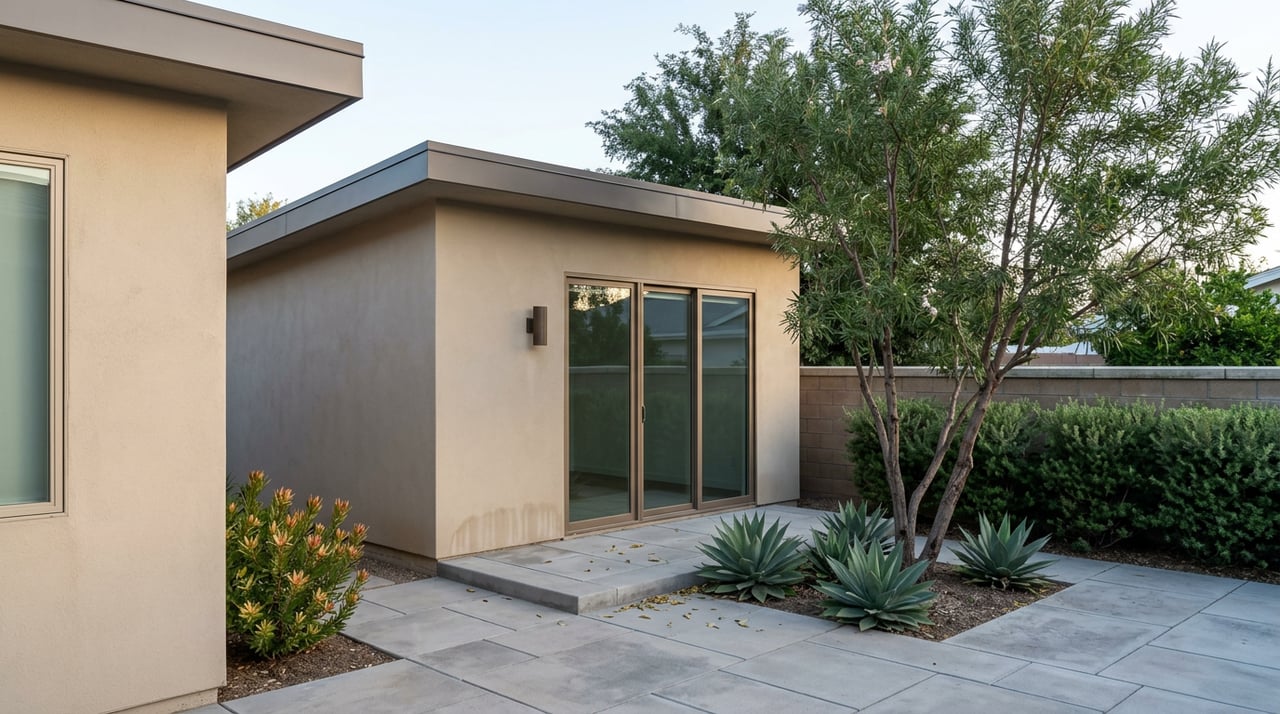
In Encinitas, 749 Square Feet Is a Financial Decision, Not a Floor Plan
September 17, 2026
September 17, 2026
A homeowner in Olivenhain draws up plans for a backyard unit. The architect sketches something comfortable: a bedroom, a living area, a kitchen that doesn't feel like an afterthought. The design lands at 900 square feet. Reasonable, by any measure.
Then the fee schedule shows up, and the math changes everything.
Under the city's updated development impact fee framework, adopted by the Encinitas City Council in Resolution No. 2026-34 and in effect since July 20, 2026, an accessory dwelling unit under 750 square feet owes the city nothing in development impact fees. A state law exemption requires it, and the city carries that exemption forward as a floor beneath its own fee schedule. Cross into 750 square feet or larger, and the fee applies to the entire structure, calculated at the same per-square-foot rate charged to a new single-family home. At the roughly $18 per square foot the city's nexus study now applies, a 900-square-foot ADU owes something in the neighborhood of $16,200 in city development impact fees alone. The identical unit built at 749 square feet owes zero.
That is not a sliding scale. It's a cliff. And for anyone weighing an ADU in Encinitas right now, whether for a parent, a tenant, or a long-term rental strategy, the location of that cliff matters more than almost any other line item in the budget.
Most ADU guides walk through setbacks, height limits, and parking exemptions. Those rules matter, but they don't change the fee owed. Square footage does, and it changes it all at once rather than gradually.
Here's the comparison that actually drives the decision:
| ADU Size | City Development Impact Fee | Approximate Fee Owed |
|---|---|---|
| 500 sq ft | Waived (under 750 sq ft threshold) | $0 |
| 749 sq ft | Waived (under 750 sq ft threshold) | $0 |
| 750 sq ft | Applies to full structure at ~$18/sq ft | ~$13,500 |
| 900 sq ft | Applies to full structure at ~$18/sq ft | ~$16,200 |
| 1,200 sq ft (max allowed) | Applies to full structure at ~$18/sq ft | ~$21,600 |
A single square foot separates the second and third rows on this table by roughly $13,500. That gap didn't exist before this year in this form. Encinitas had waived most impact fees for ADUs under 750 square feet already, but the citywide nexus study finalized in May and implemented in July recalibrated the rate applied above that line, and the city's own reporting on the change, along with coverage in Hoodline, notes the new schedule pushes costs for larger units up to roughly that $18-per-square-foot figure, a meaningful jump from what builders had been quoting clients previously.
This is also layered on top of a separate, smaller threshold. School impact fees in Encinitas kick in once an ADU crosses 500 square feet, regardless of the 750-square-foot line for citywide development fees. A homeowner building a 600-square-foot unit avoids the big development impact fee but still owes the school fee. Someone building a 450-square-foot JADU avoids both, since junior units are capped at 500 square feet under state law and typically fall well under either threshold.
The fee changes aren't an isolated ADU policy. They're one piece of a broader cost-recovery push that the Encinitas City Council has been working through in stages this year.
Effective July 1, 2026, the city automatically raised its planning and engineering service fees by 3.8 percent, tied to the Consumer Price Index, under Council Resolutions 2026-52 and 2026-53. On August 19, the council approved a matching 3.8 percent bump to sewer-related engineering and service fees. Then, on September 16, six days from today, the council is scheduled to give final approval to a much larger fee overhaul, one city officials estimate could bring in close to $1.5 million in additional revenue. That package touches coastal development permits, agricultural permits, property boundary line adjustments, and business registration renewals. If approved as planned, the new schedule is expected to take effect in late October.
The stated logic, laid out in the city's FY 2026-27 budget forecast, is that rising labor costs and aging infrastructure mean the General Fund has effectively been subsidizing private development applications, and the city wants fees that match what it actually costs to process them. Whatever one thinks of that rationale, the practical takeaway for anyone planning an ADU is that Encinitas has spent 2026 systematically moving fees closer to full cost recovery, category by category. The 750-square-foot ADU threshold is the version of that trend that landed first and hits hardest, because it isn't a percentage bump. It's a fee that goes from nothing to five figures depending on which side of one number your unit falls on.
Construction costs for ADUs in North County San Diego typically run from around $150,000 to $350,000 or more, with garage conversions on the lower end of that range and new detached construction, especially anything approaching the 1,200-square-foot maximum, at the higher end. Junior ADUs built within existing space tend to run less, often in the $80,000 to $150,000 range, since they use the home's existing foundation and walls.
Against those numbers, a $13,500 to $16,200 swing in city fees is not trivial, but it also isn't the deciding factor on its own. What it does is change the return math at the margin. An investor comparing a 700-square-foot one-bedroom to a 900-square-foot two-bedroom needs to weigh the extra bedroom and higher achievable rent against a construction cost bump plus a development impact fee that the smaller unit simply doesn't owe. ADUs in North County San Diego typically rent in the range of $1,800 to $3,500 a month depending on size, finish level, and proximity to the coast. A larger unit might command real rent, but the fee gap has to be part of that comparison, not an afterthought discovered at permit issuance.
There's a second wrinkle worth knowing before you commit to a design. If your property relies on a septic system, and parts of Encinitas do, adding an ADU generally requires a capacity review, and you may need to upgrade the system to support the additional unit. That can be a significant cost and schedule factor independent of the square footage fee question, so it's worth resolving early, ideally in the same pre-application conversation where you're deciding how big to build.
One piece of good news buried in the fee conversation: within the Coastal Zone, which covers a large share of Encinitas, a Coastal Development Permit is required for most ADU projects, but it does not carry its own separate fee beyond what's processed with the building permit. The review can add time to your timeline, but it doesn't add another line item to the invoice the way the development impact fee does.
The city's public notices give a real-time look at how homeowners are responding. Recent filings include a new 1,200-square-foot detached ADU approved at 1403 Burgundy Road, a conversion of an existing garage and single-family space into an ADU at 755 Blossom Road, and straightforward detached ADU construction at both 1027 Hygeia Avenue and 863 Normandy Road. One filing legalizes an existing 466-square-foot detached unit at 1710 Glasgow Avenue under Assembly Bill 2533, which allows cities to bring pre-2020 unpermitted ADUs and JADUs into compliance. Two more projects, a standard ADU at 250 La Mesa Avenue and a JADU garage conversion at 1387 Lake Drive, are still working through the city's notice process.
That mix tells its own story. Some homeowners are still building at the maximum size regardless of the fee, usually because the primary goal is multigenerational housing rather than a return calculation. Others are converting existing garages, a path that tends to land well under 750 square feet almost by default, since most garages simply aren't that large to begin with. The fee threshold doesn't dictate every decision, but for anyone building with rental income as the primary goal, it's now impossible to ignore.
Does the 750-square-foot fee threshold apply to JADUs? No. Junior ADUs are capped at 500 square feet under state law, so they fall well under the development impact fee line regardless. They do, however, cross the separate 500-square-foot threshold that triggers school impact fees.
Could the 750-square-foot line move again? The fee amount tied to that threshold is scheduled to adjust annually starting in 2027, based on regional construction cost indexing. The September 16 vote covers a different set of fees, including coastal permits and business registration, not the ADU development impact fee itself, but it signals the city's continued direction toward full cost recovery across the board.
Does the Coastal Development Permit add cost on top of the impact fee? Within the Coastal Zone, the CDP is processed with the building permit at no additional fee, though it can extend review time, particularly for properties near bluffs or in special study overlay zones.
The 750-square-foot line isn't a rule to memorize and move past. It's a number that should sit next to your rent comps and your contractor's bid before a single wall gets drawn, because it changes the actual return on the unit you're about to build. If you're weighing an ADU on an Encinitas property, whether for family, for rental income, or as part of a larger renovation plan, that's exactly the kind of local detail worth a real conversation before the design is locked.
FW Property Group works with Encinitas homeowners and investors on exactly this kind of decision, from sizing a unit against current fee thresholds to coordinating the renovation and rental strategy around it. Request your free home valuation to start that conversation.
Stay up to date on the latest real estate trends.

We pride ourselves in providing personalized solutions that bring our clients closer to their dream properties and enhance their long-term wealth. Contact us today to find out how we can be of assistance to you!