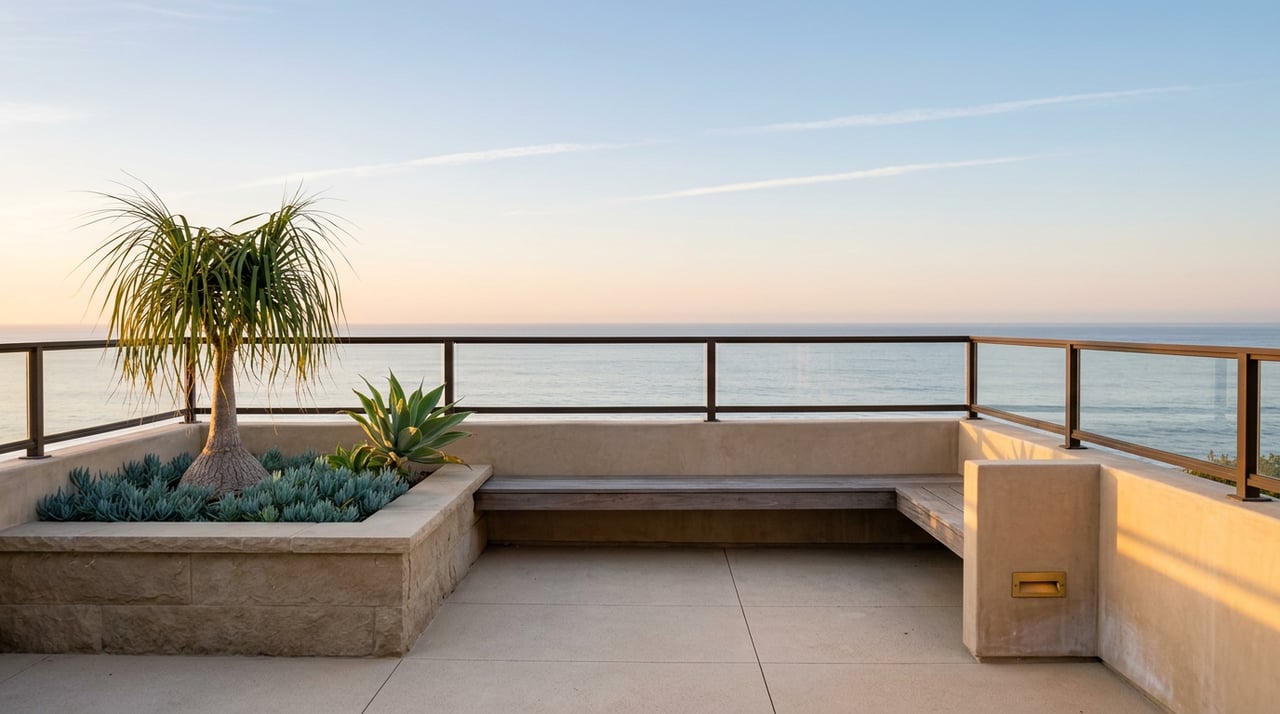
In La Jolla, a Big Remodel Can Quietly Cancel Your Home's Seawall Rights
September 17, 2026
September 17, 2026
In April 2026, homeowners on Calumet Avenue in Bird Rock watched the ground beneath their back patios start to give way. The erosion had been advancing for months, but that spring it moved fast enough that the structures had to come down before the bluff took them down first. A few doors away, at 5322 Calumet, a California Coastal Commission report from August 2025 had already found erosion advancing to within eight feet of the primary residence, pushing the site's factor of safety well below the 1.2 threshold that triggers emergency action. By the time a San Diego hearing officer approved a 70-foot seawall for the neighboring home at 5360 Calumet this August, that stretch of coastline had processed its third seawall application in a handful of years.
The wall itself is being engineered to disappear into the cliff. It will be hand-carved to match the bluff's color and texture, built from two feet of shotcrete anchored by 21 tiebacks drilled into the rock face, and required to include a sand replenishment fee to offset what construction removes from the beach below. It is a serious, expensive, carefully permitted piece of coastal engineering.
It is also, legally, a special case. The home at 5360 Calumet was built in 1985, eight years after the California Coastal Act took effect, which means it does not get to armor itself on the strength of erosion risk alone. Under Section 30235 of the Act, shoreline protection is guaranteed only for structures that existed before January 1, 1977. Everything built after that date, no matter how threatened, has to clear a higher bar: proof of imminent danger and no feasible alternative. That distinction, buried in a 1976 statute, is the thing every bluff-top buyer and seller in La Jolla should understand before they fall in love with a view.
Most people evaluating an oceanfront home ask whether it has a seawall. That is the wrong first question. The right one is when the house was built, because the Coastal Act does not treat all existing structures equally.
Homes built before 1977 are treated as pre-dating the Act itself, and Section 30235 gives them a real claim to armoring if erosion threatens them. Homes built after that date do not inherit the same protection. A 2026 home on an eroding bluff can still apply for a seawall, but it has to demonstrate the danger is immediate and that nothing short of hard armoring will work, a standard the Calumet Avenue case had to meet.
| Built before January 1, 1977 | Built after January 1, 1977 (or substantially remodeled) | |
|---|---|---|
| Right to shoreline armoring | Recognized as an existing structure under Section 30235 | No guaranteed right; must show imminent danger and no feasible alternative |
| Typical permit condition | Can seek a CDP based on documented erosion threat | Often conditioned on a Waiver of Future Shoreline Protection |
That second column is where the real risk lives for anyone buying an older bluff-top property with a plan to renovate.
A pre-1977 home with an existing, permitted seawall carries real value. It has the one thing a newer neighbor can't easily get: a legal claim to protection if the bluff keeps eroding. But that status is not permanent, and it is not tied to the age of the house so much as to how much of the house still exists in its original form.
Local coastal programs define a "substantial remodel" threshold, usually measured as a percentage of a structure's major components or as a share of the home's value being replaced, and the exact number varies by jurisdiction. Cross that line and the home effectively stops being the 1965 structure the Coastal Act protected. It becomes new construction in the Commission's eyes, and new construction on a bluff is typically conditioned on a Waiver of Future Shoreline Protection, meaning the owner formally gives up the right to build or maintain a seawall as a condition of getting the renovation permit at all.
In practice, that means a buyer who purchases an older La Jolla oceanfront home specifically because it comes with existing armoring, then commissions an ambitious renovation without checking where the remodel threshold sits, can end up trading away the protection the seawall represented. The wall might still be standing. The legal right to keep it there is what disappears.
Two regulatory shifts landed in 2026, and it is worth being precise about what each one touches, because neither one softens the substantial remodel risk.
On April 23, 2026, the California Supreme Court issued a unanimous ruling in Shear Development Co. v. California Coastal Commission that limits the Commission's authority to override permits already approved by a city or county under its certified Local Coastal Program. Chief Justice Patricia Guerrero wrote that "neither the county nor the commission, as local and state entities respectively, should have greater deference" in interpreting those local plans. For a bluff-top project in La Jolla, that ruling reduces the odds that a City-approved permit gets reversed on appeal. It says nothing about bluff stability, nothing about setback distances, and nothing about the remodel threshold. It changes who has the final word once a project is approved. It does not change what gets a project approved in the first place.
The second shift is more concrete for anyone planning to build. On July 1, 2026, San Diego's coastal bluff setback guidance increased total required setbacks from roughly 53 to 55 feet up to 63 to 64 feet, a jump driven by updated sea level rise projections and erosion modeling specific to segments of coastline including La Jolla and Bird Rock. Projects deemed complete before June 30, 2026 were reviewed under the older, smaller setback. That window has already closed. Anyone submitting a bluff-top addition, remodel, or ADU application today is working against the new, larger number, which on a constrained lot can mean a meaningful reduction in buildable area exactly where a renovation might otherwise want to expand.
Put the two together and the picture is this: it just got somewhat harder to appeal your way out of a denied permit, and it got measurably harder to fit a large addition near the bluff edge. Neither change touches the seawall rights question at all. That risk was already baked into the Coastal Act fifty years ago, and it is the one most buyers and sellers still don't ask about.
If you're selling a pre-1977 oceanfront home in La Jolla with an existing seawall, the value of that armoring depends on the permit history staying intact. Before you plan any renovation, confirm what percentage of the structure your project will actually touch, and get that number checked against the local remodel threshold before design work goes further than a sketch. A kitchen refresh is unlikely to move the needle. A full second story or a ground-up rebuild almost certainly will.
If you're buying, ask for the seawall's permit history directly, not just its physical condition. A finaled, permanent Coastal Development Permit tells you the protection is real. A seawall built without one, or one attached to a home that has already been substantially remodeled since it was installed, may be worth far less than it appears on a walkthrough. You can check a property's coastal zone status yourself using the California Coastal Commission's public parcel map before you ever write an offer.
This is also where renovation planning and listing strategy have to happen in the same conversation rather than as two separate steps. A seller who wants top dollar for a bluff-top home often assumes cosmetic upgrades are the safe move and structural changes are the risky one. On the coast, the calculation runs the other way. Cosmetic work rarely trips the remodel threshold. It's the ambitious structural project, the one most likely to impress a buyer walking through, that can quietly cost the house its armoring rights.
Does selling a bluff-top home require Coastal Commission approval? No. The sale itself doesn't require any CDP action. What matters is disclosing the property's coastal zone status and its permit history, including whether the seawall has a finaled CDP, so the buyer isn't discovering the armoring's legal status during their own due diligence.
Can I add a rooftop deck or expand a footprint without affecting seawall rights? It depends entirely on how that addition is measured against the local coastal program's substantial remodel threshold. Some jurisdictions calculate this by percentage of structural components replaced, others by construction valuation. The only reliable answer comes from checking your specific project against your specific city or county's definition before finalizing design.
What if the seawall was built by a previous owner and I don't have documentation? Request the full permit history from the city's Development Services department before closing. An unpermitted or undocumented seawall on a coastal property can complicate both the current sale and any future renovation, since the next owner will inherit whatever gaps exist in that paper trail.
Coastal armoring, remodel thresholds, and shifting setback rules are exactly the kind of detail that separates a smooth bluff-top transaction from a mid-escrow surprise. If you're weighing a renovation before listing, or evaluating an oceanfront purchase in La Jolla or Bird Rock, FW Property Group can walk through what your specific property's permit history and remodel plans actually mean before you commit to either. Request your free home valuation to start that conversation.
Stay up to date on the latest real estate trends.


We pride ourselves in providing personalized solutions that bring our clients closer to their dream properties and enhance their long-term wealth. Contact us today to find out how we can be of assistance to you!